

Years ago, I proceeded to tell a friend some piece of etymological trivia I’d picked up who-knows-where. That stopped her in her tracks; she noted how niche my interests were. I tried to find the message or the tone endearing but, to this day, I keep failing.
This is how neurodivergence can look like and that is the kind of “feedback” you might receive — although it was to be another decade or so before I could better grasp such things. Thank Descartes for the side-quests I started finding in the early 2010s and for how they demonstrated that I could never have been the only one who cared about something like that.
One quest I took was a Coursera MOOC (massive open online course) — Archeology’s Dirty Little Secrets from Brown University. Sadly, this is not available anymore (but I do have my eye on other offerings). I remember that most weekly assignments came in sets from which the students could choose a favourite. “Write like an Akkadian” was one such assignment option, complete with suggestions and resources for more information.
This is what I submitted for peer review.
I simply had to go for option #3! A chronological depiction of my adventure ensues.
I enthusiastically clicked on the links provided. The first one led me to the website for the Open Richly Annotated Cuneiform Corpus (ORACC). I had to install at least one cuneiform font, so I installed three (Old Babylonian, Neo-Assyrian and Composite).
My name is Lavinia (four syllables). I transliterated it for "cuneification" by writing it as a collection of "eligible" syllables I picked from but I had to go with "wi" to replace the "vi". My friends from Pakistan tend to pronounce the "v" in my name with a bit an of English "w" sound in it, so it feels like an adequate choice. I transliterated my name following the rules provided (looked up the possible syllables and chose open ones to write it as la-wi-ni-a in Cuneify.
I read a bit more on phonology to imagine how an Akkadian would have pronounced my name. The "l" would have been a "liquid", soft sound. The "n" would have had a more nasal sound. The "w" is a semi-vowel (glide); the rules state that "when a vowel and glide are next to each other, they often elide too, so that a vowel plus y is written as a long vowel. But a vowel plus w always becomes a long "u"." Since the "w" in "Lawinia" starts a syllable, I was not convinced that this rule applies and "Lūinia" is my Akkadian name. After reading further about sound rules, my name seems to follow the general rules for words: it does not start with more than one consonant, it does not have clusters of three or more consonants mid-word; no short vowels that could be suppressed if they were between two consonants, since "w" is a glide.
However, I decided to take a look at the closed syllables — consonant-vowel-consonant, only to discover that there is a "lah". I then realized that "Lah-wi-ni-a" could avoid some of the potential risks posed by the glide, so I wrote all three variants on the tablet, which reads:
Lawinia
Lūinia (my personal least favorite :))
Lahwinia
I went and bought modelling clay today. It's not a very soft clay, so I could only successfully make a small tablet, about the size of my palm. I used toothpicks to write, because chopsticks were way too big for the tablet. I didn't have natural light at the time I finished, so the picture may not be very accurately showing shadow-prone details.
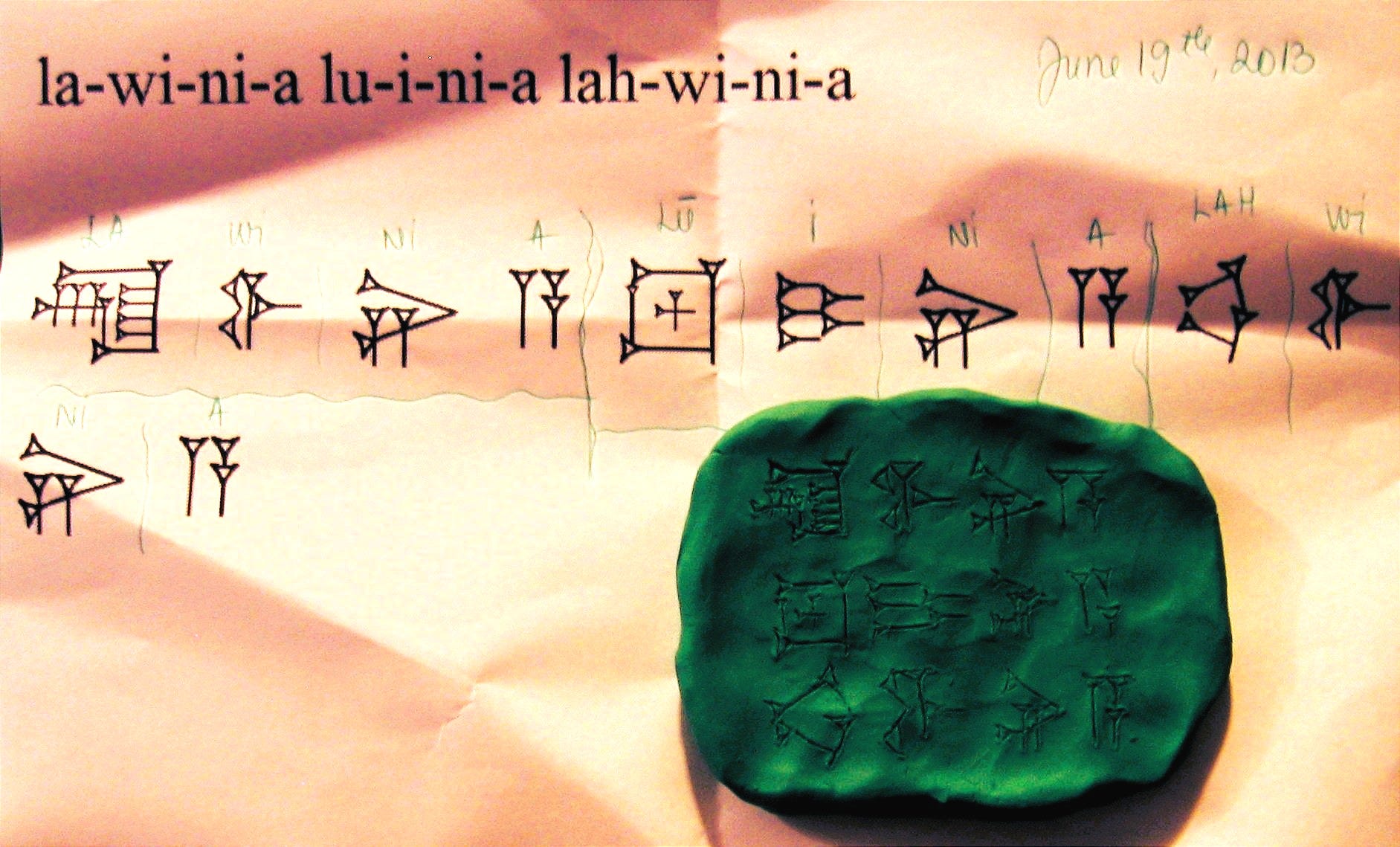
I truly enjoyed this exercise. My native language uses the Latin alphabet and I am also familiar with Cyrillic and Greek alphabets (mostly one sound = one symbol), but I have recently started learning Hindi and the cuneiform concept seems to resemble Devanagari in that it employs largely one syllable = one symbol and contractions.
peer 1 → Very impressive, your name is lovely and your tablet is fabulous. I would give you 3+
peer 2 → Very cool! I really enjoyed reading your response and seeing your results. I certainly feel like I learned something too! Very well organized and thoughtful work.
peer 3 → WOW! I did not attempt this assignment because it was very complicated! I am very impressed by the author's effort, planning, execution and the tablet the author made! AMAZING!
peer 4 → The work completed all required steps in the exercise, reaching the minimum word count. Enthusiasm was evident from the start! How refreshing. The work was clearly expressed, it is very obvious you put a lot of effort, energy and care in to your work. Just hearing about how much fun you had and how enthusiastic you were was interesting enough, and shows great originality of thought in the way you attempted three different renderings of your name. Of course, I must say the work was meant to be done with chopsticks, but all can be forgiven and it makes no difference, seeing as you understood what you were doing and understood the assignment perfectly well (plus, as you said, the chopsticks were just too big for the tablet). Well done.
peer 5 → This work is excellent! I am really interested in the linguistic approach you took with writing your name, rather than just a transliteration. It is too bad your clay didn't work out better, but you have really understood the language part of the assignment.